 Nuôi Cá
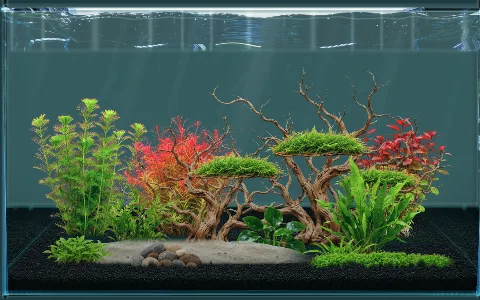
Composition and sight lines
Attach thin moss layers along branches to form descending tiers. Siphon clippings immediately to keep moss out of the sand.
Components and positions in this example
Counts describe clusters in the illustrated example, not pots, kilograms or shopping quantities. Actual amounts depend on tank dimensions and mature plant size. Front/middle/back are relative positions; open each component for care details.
| Component | Position | Example clusters |
|---|---|---|
| Cabomba | Back | 1 |
| Rotala wallichii | Back | 1 |
| Red ludwigia | Back | 1 |
| Spider wood | Back, Middle | 2 |
| Christmas moss | Middle | 3 |
| Java fern | Middle | 1 |
| African water fern | Middle | 1 |
| Anubias nana | Middle | 1 |
| Sand bank | Front | 1 |
| River pebbles | Front | 1 |
| Crypt parva | Front | 1 |
| Staurogyne | Front | 1 |
| Monte Carlo | Front | 1 |
Tank, substrate and equipment
Choose tank dimensions for adult livestock, groups and required floor area; the preset does not establish a real tank volume. Prepare a substrate suited to plant nutrition, serviceable biological filtration, thermometer, timed lighting, planting/pruning tools, siphon and water tests. Select heating or cooling from livestock and room conditions.
The list includes plants requiring a CO₂ plan. For a tank without injection, replace those plants with suitable alternatives that retain their compositional role rather than promising the original result under all conditions.
Wood/leaves can release colour and add organic load. Test materials separately and check buoyancy; tea colour does not establish low GH.
Assembly sequence
- Plan the focal point, open areas, equipment placement and cleaning access before buying materials.
- Test rock/wood stability before adding livestock; avoid concentrated glass loads and fish-trapping gaps.
- Separate planted substrate from decorative sand with suitable boundaries.
- Plant by growth form: attach epiphytes, expose rooted crowns and divide stems/carpets with room to grow.
- Fill carefully, run equipment and check circulation behind hardscape.
- Use fishless cycling and evaluate water before stocking; a completed picture does not establish filter readiness.
Maintenance that preserves the composition
Photograph after pruning to track encroachment into open space. Rotate trimming, siphon clippings and inspect wood bases and intakes. Avoid replacing all media, disturbing the substrate and stripping plants together merely to match the original picture.
Before stocking
Sources and editorial approach
- Tropica — Planting
Planting by growth form; the particular composition is TLife editorial guidance.
- RSPCA — Water quality and biological filtration
Water and biological filtration; a finished layout does not establish cycling.
Layout capture from the Nuôi Cá 3D aquarium. This is composition guidance rather than a real husbandry trial or stocking guarantee. Sources apply to planting and water; style names do not establish habitat, salinity or livestock.
Layouts with related components
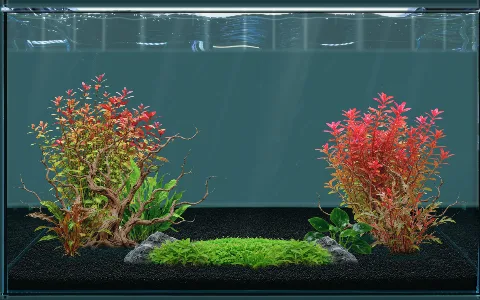 Concave valleyRaise planted wood at both edges and lower the central valley. Keep the central sight line open after growth, not just on planting day.
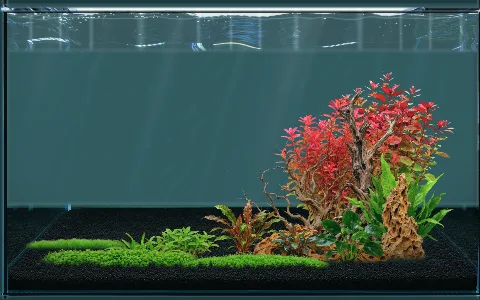 Triangle layoutBuild height on the right and taper leftward. Keep basal planting low so the diagonal survives trimming and regrowth.
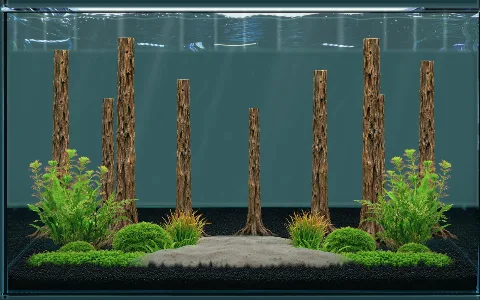 Flooded forestUse trunks for vertical structure, attached plants at their bases and sand for viewing windows. Keep wood bases accessible for cleaning.