 Nuôi Cá
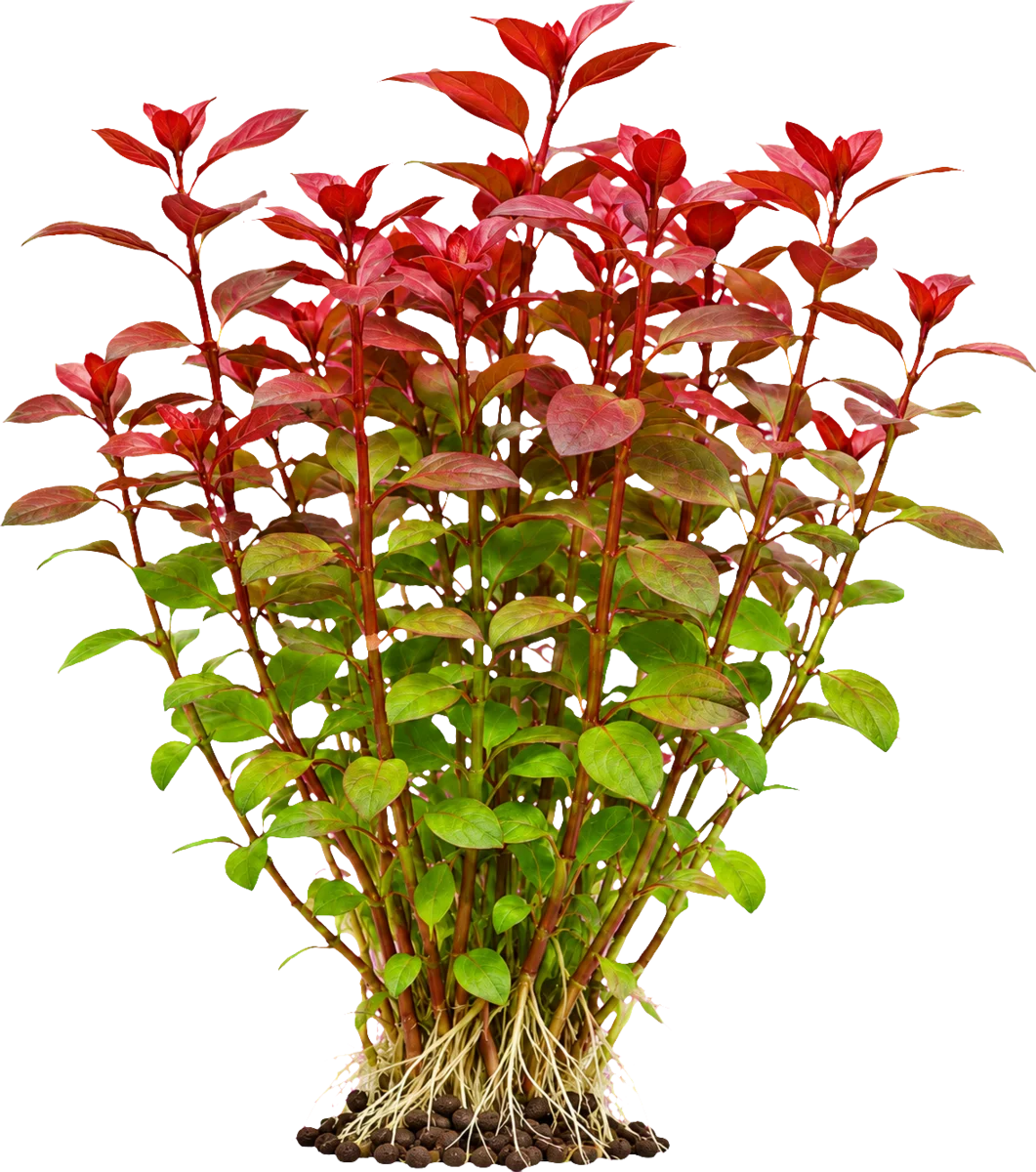
Where Red ludwigia comes from
Ludwigia repens belongs to the evening primrose family (Onagraceae) and is native to North and Central America, from the southern United States through Mexico to the Caribbean, growing in and along streams, ponds, swamps and ditches, both on wet mud and submerged. The opposite leaves are oval to nearly round, 1–3 cm long, olive green to reddish brown above and pinkish red below; stems can reach 50 cm, rising and then creeping over the surface. Many plants in the trade are hybrids of L. repens and L. palustris or selected forms such as "Rubin", so leaf shape and color vary from one source to another.
Growing Red ludwigia in a planted aquarium
In a planted aquarium Ludwigia repens grows in medium light without CO2, but strong light, CO2 and moderate nitrate turn the leaves a deeper red. Growth is moderate, and it looks best as a group in the background or a side corner of an aquascape, contrasting with green plants. How to grow it: push stems a few centimeters into the substrate, spaced so light reaches the lower leaves. Trim the tops and replant them; the old stems will branch. Low light or iron shortage gives small, pale leaves and bare lower stems. It tolerates a wide range of water and temperature and is a reliable plant for beginners.
At a glance
- Scientific name
- Ludwigia repens
- Light
- Medium
- CO2
- Helpful
- Growth
- Medium
- Difficulty
- Easy
- Place in a layout
- Background plants
Light, CO2 and growth are typical levels; the same plant can grow differently with each tank's light, substrate and water.
In the Nuôi Cá aquarium
In the arrange tray it sits with the background plants; at its base size it is about 24 cm tall, and you can scale it, flip it and set it nearer or deeper. Its leaves sway in the current from the filter and wave maker. Under the tank light it pearls small oxygen bubbles.
Try it in your aquarium →Sources and further reading
- GBIF — Ludwigia repens (scientific name, taxonomy and native range)
- OATA — freshwater aquarium care sheets (real aquarium care principles)
The "In the Nuôi Cá aquarium" part describes the 3D simulation, not real planting advice.