 Nuôi Cá
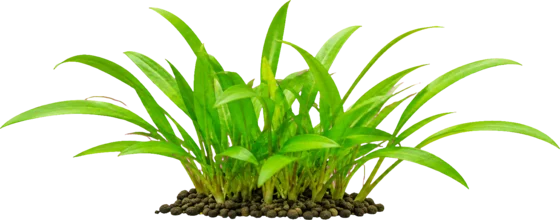
Where Crypt parva comes from
Cryptocoryne parva is an aroid (family Araceae) endemic to Sri Lanka and is usually regarded as the smallest Cryptocoryne species. In the wild it grows along streams and on seasonally flooded ground, spending much of the year emersed on wet mud and going under water in the rainy season. It has no upright stem; the narrow, lance-shaped leaves are plain green and usually about 3–6 cm tall when submerged. It spreads slowly by underground runners into low clumps. The small spathe rarely appears under water.
Growing Crypt parva in a planted aquarium
In a planted aquarium Crypt parva needs medium light or more to stay compact; in shade the leaves stretch. CO2 helps but is not required. Because it grows so slowly, plant it densely from the start, setting individual plantlets in the foreground. Like other crypts it is prone to "crypt melt" after a move or a sudden change in water, but new leaves return as long as the roots survive. It is a heavy root feeder that likes a rich substrate or root tabs, and it dislikes being disturbed. Easy care, but it takes patience.
At a glance
- Scientific name
- Cryptocoryne parva
- Light
- Medium
- CO2
- Helpful
- Growth
- Slow
- Difficulty
- Easy
- Place in a layout
- Foreground and carpet plants
Light, CO2 and growth are typical levels; the same plant can grow differently with each tank's light, substrate and water.
In the Nuôi Cá aquarium
In the arrange tray it sits with the foreground and carpet plants; at its base size it is about 6 cm tall, and you can scale it, flip it and set it nearer or deeper. Its leaves sway in the current from the filter and wave maker.
Try it in your aquarium →Sources and further reading
- GBIF — Cryptocoryne parva (scientific name, taxonomy and native range)
- OATA — freshwater aquarium care sheets (real aquarium care principles)
The "In the Nuôi Cá aquarium" part describes the 3D simulation, not real planting advice.