 Nuôi Cá
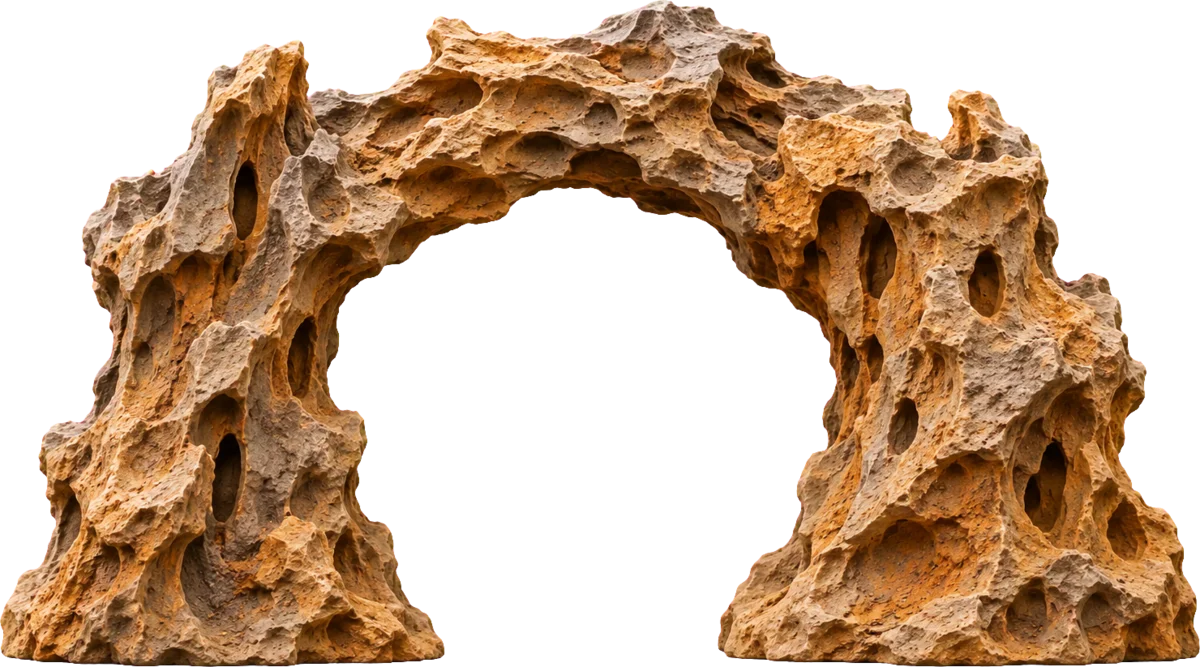
Where Stone arch comes from
One-piece arches are rare, because the stone has to weather through while staying strong; with Ohko (dragon stone), the porous hardened clay stone from China, pieces with natural through-holes do turn up. Most arches in real aquascapes are built from two or three stones joined with cyanoacrylate gel, epoxy or mortar, then dusted with substrate or sand to hide the joint. Ohko is a trade name, and the stone's exact geological nature is still debated.
Stone arch in an aquascape
Dragon stone is considered close to inert and does not change pH or hardness. An arch must be completely stable: stand both feet on the bottom glass over a protective mat, bury them deep and test the joints before filling, since a falling arch can crack the glass. Place it in the midground, off center, with the opening aimed so you see distance through it. Moss, Bucephalandra and small anubias tied over the top soften its lines, and schooling fish like to swim through. Rinse the clay out of the holes first. Medium difficulty, because it has to be built solidly.
At a glance
- Material
- Hardened claystone
- Effect on water
- Inert: leaves the water chemistry alone
- Place in a layout
- Stones, driftwood and decor
The effect on water is what this material usually does; real stone and wood vary from batch to batch, so soak a piece and test pH and KH before it goes in the tank.
In the Nuôi Cá aquarium
In the arrange tray it sits with the stones, driftwood and decor; at its base size it is about 29 cm wide, and you can scale it, flip it and set it nearer or deeper. Shrimp and snails can climb along its top to graze.
Try it in your aquarium →Sources and further reading
- OATA — freshwater aquarium care sheets (real aquarium care principles)
The "In the Nuôi Cá aquarium" part describes the 3D simulation, not real planting advice.