 Nuôi Cá
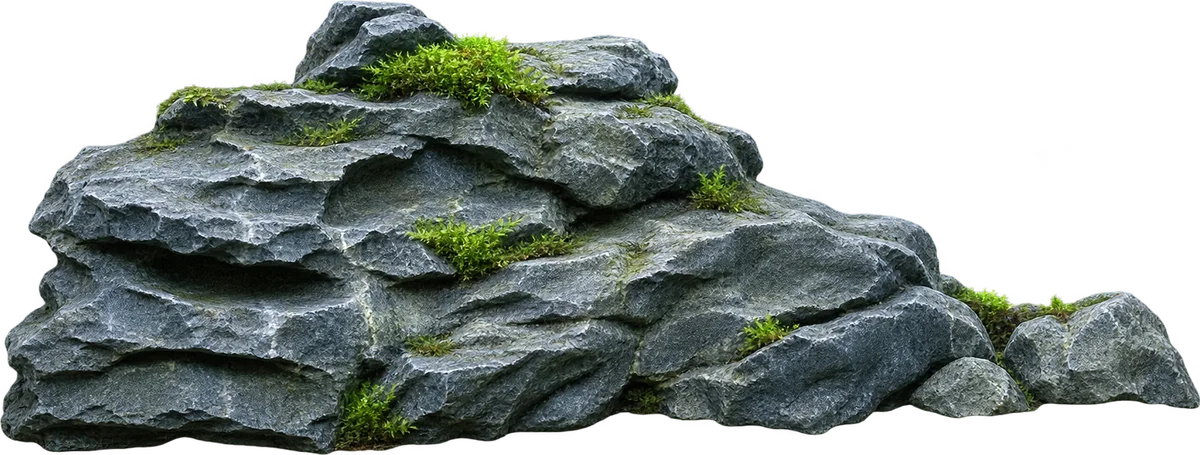
Where Seiryu stone comes from
The name Seiryu (Seiryu-seki, roughly "blue dragon stone") originally referred to a Japanese stone, but almost all Seiryu sold today is gray limestone quarried in China, sometimes sold as mini landscape stone. It is a dense limestone, gray to bluish gray, crossed by white calcite veins, with a rugged surface of ridges and cracks running mostly one way. Because the veins and ridges line up, the stones group well and look as if they came from the same mountain.
Seiryu stone in an aquascape
As a limestone, Seiryu slowly dissolves calcium carbonate and raises hardness (KH and GH) and pH, most noticeably in a small tank with a lot of rock and few water changes. A drop of vinegar or acid on it fizzes. That is fine for most fish and plants, and aquasoil buffers part of it, but avoid heavy use with Crystal shrimp, Caridina or fish that need very soft water. Scrub the mud out of the cracks before scaping. Set the group on the rule of thirds, bury the base partly in the substrate so it looks rooted and stable, and keep the ridges slanting the same way.
At a glance
- Material
- Limestone
- Effect on water
- Raises hardness and pH
- Place in a layout
- Stones, driftwood and decor
The effect on water is what this material usually does; real stone and wood vary from batch to batch, so soak a piece and test pH and KH before it goes in the tank.
In the Nuôi Cá aquarium
In the arrange tray it sits with the stones, driftwood and decor; at its base size it is about 15 cm tall, and you can scale it, flip it and set it nearer or deeper. Shrimp and snails can climb along its top to graze.
Try it in your aquarium →Sources and further reading
- OATA — freshwater aquarium care sheets (real aquarium care principles)
The "In the Nuôi Cá aquarium" part describes the 3D simulation, not real planting advice.