 Nuôi Cá
Where Lemon bacopa comes from
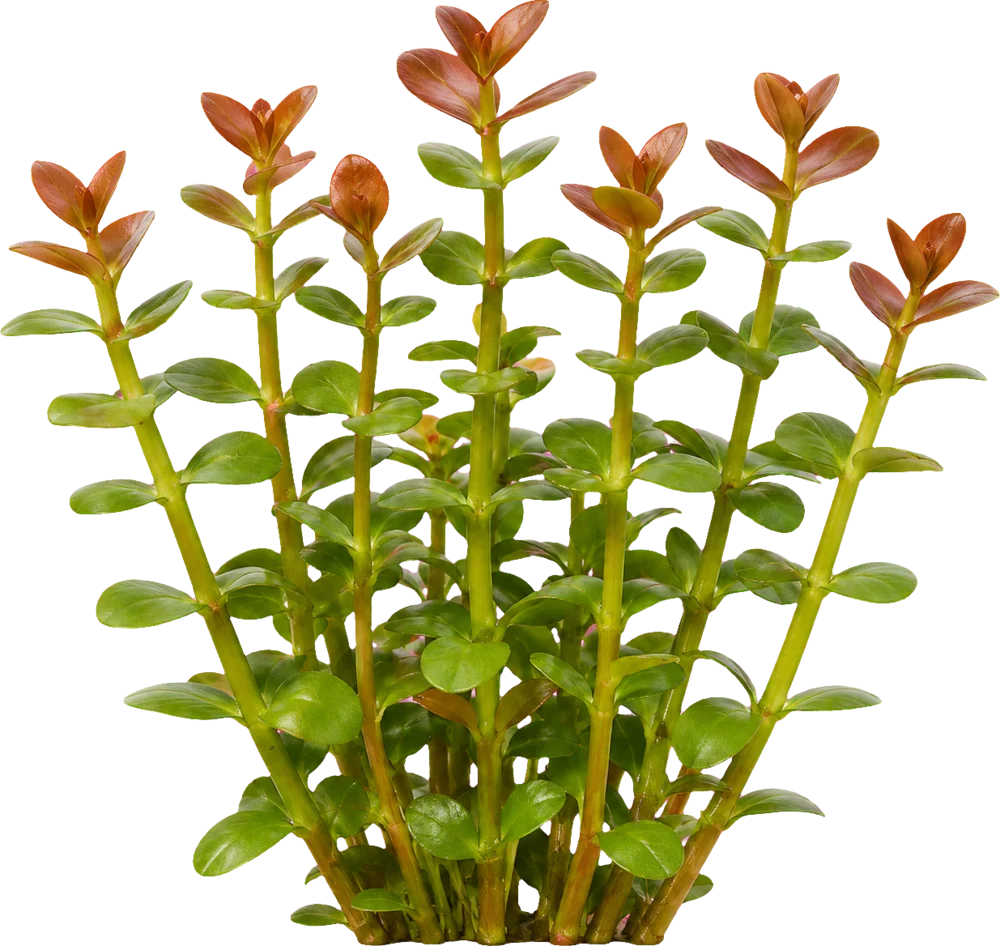
Bacopa caroliniana belongs to the plantain family (Plantaginaceae) and is native to the southeastern United States, from Virginia to Florida and Texas, as well as parts of Central America and the Caribbean, growing in marshes and along ponds and streams, often creeping over wet mud or partly submerged. The stems are stout and slightly hairy; the opposite leaves are oval, thick and fleshy, 1.5–2.5 cm long, and smell faintly of lemon when crushed, hence its common name. Emersed plants bear small blue flowers. Underwater stems reach about 30–40 cm.
Growing Lemon bacopa in a planted aquarium
In a planted aquarium lemon bacopa grows in low to medium light without CO2; stronger light and CO2 turn the tips coppery pink and make it bushier. It grows fairly slowly and needs little trimming, and its upright habit suits the background or midground of an aquascape, planted as a row of stems a few centimeters apart. How to grow it: push stems 3–5 cm deep; they root at the nodes. Propagate by cutting the tops; old stems branch slowly. The thick leaves are seldom eaten by fish or snails. Potassium or iron shortage shows as pale new growth. It is a very easy plant for beginners.
At a glance
- Scientific name
- Bacopa caroliniana
- Light
- Medium
- CO2
- Helpful
- Growth
- Slow
- Difficulty
- Easy
- Place in a layout
- Background plants
Light, CO2 and growth are typical levels; the same plant can grow differently with each tank's light, substrate and water.
In the Nuôi Cá aquarium
In the arrange tray it sits with the background plants; at its base size it is about 20 cm tall, and you can scale it, flip it and set it nearer or deeper. Its leaves sway in the current from the filter and wave maker. Under the tank light it pearls small oxygen bubbles.
Try it in your aquarium →Sources and further reading
- GBIF — Bacopa caroliniana (scientific name, taxonomy and native range)
- OATA — freshwater aquarium care sheets (real aquarium care principles)
The "In the Nuôi Cá aquarium" part describes the 3D simulation, not real planting advice.