 Nuôi Cá
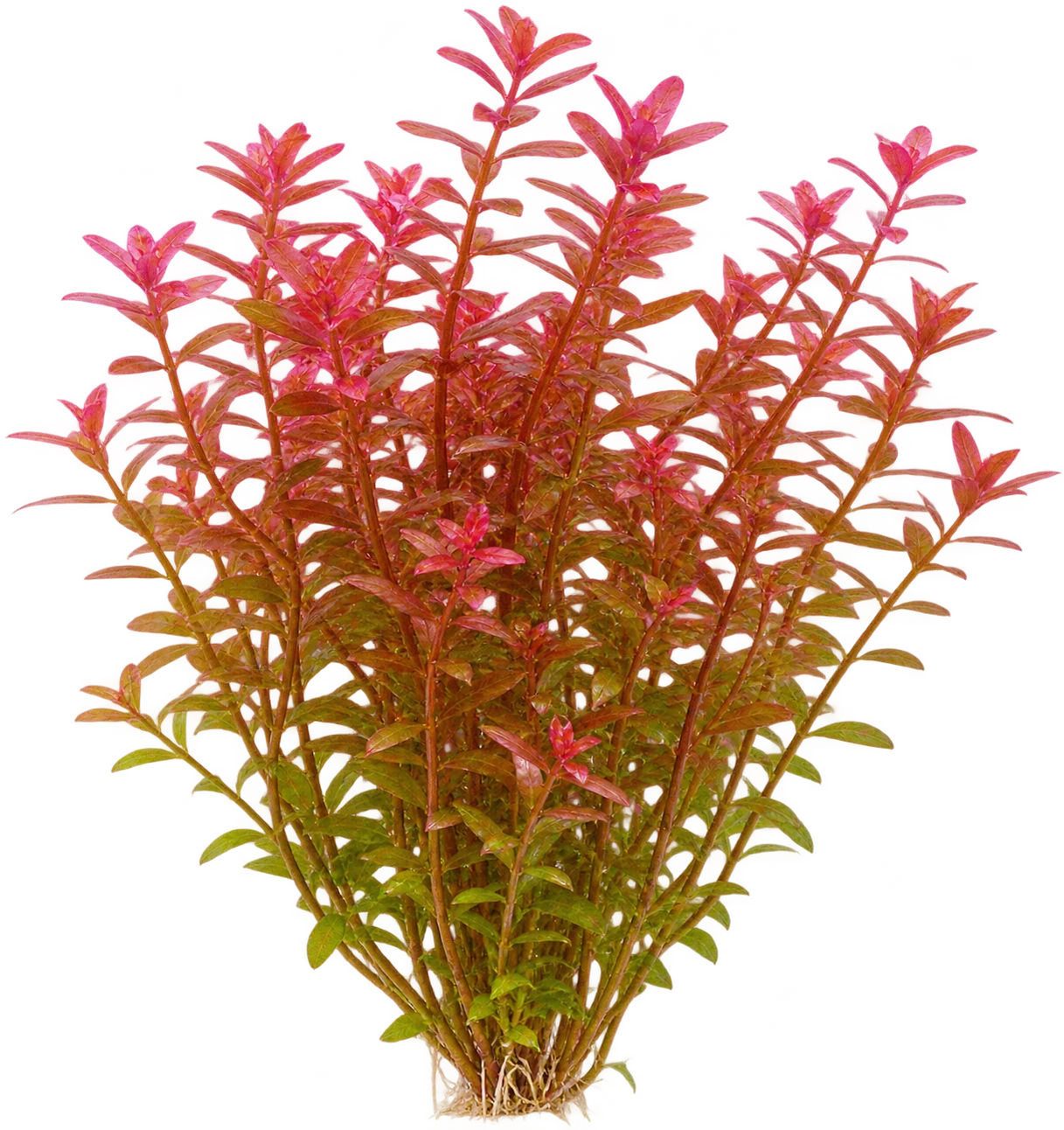
Where Red rotala comes from
Rotala macrandra is a member of the loosestrife family (Lythraceae) endemic to southern India, where it grows in marshes, flooded fields and along streams that rise over the plants in the monsoon. The emersed form has small, rounded green leaves; submerged, the leaves become much larger, oval, 2–4 cm long, paper-thin and slightly wavy, wine red beneath and pink to deep red above. The stems are brittle, branch fairly little and can reach 30–40 cm. Selected forms such as "Narrow Leaf" and "Mini" are also traded, often under the same scientific name.
Growing Red rotala in a planted aquarium
In a planted aquarium Rotala macrandra needs strong light, steady injected CO2, soft and slightly acidic water and a rich substrate with enough iron; without any one of these it fades, stunts or rots at the stem. Growth is moderate, and it works as a red accent in the background or midground of an aquascape, set against green plants to stand out. The thin leaves tear easily when handled or nibbled, so plant it gently with tweezers and leave space between stems. Trim the tops and replant them; it dislikes being uprooted repeatedly. Proper care makes it spectacular, but it is a plant for experienced keepers.
At a glance
- Scientific name
- Rotala macrandra
- Light
- High
- CO2
- Required
- Growth
- Medium
- Difficulty
- Demanding
- Place in a layout
- Background plants
Light, CO2 and growth are typical levels; the same plant can grow differently with each tank's light, substrate and water.
In the Nuôi Cá aquarium
In the arrange tray it sits with the background plants; at its base size it is about 27 cm tall, and you can scale it, flip it and set it nearer or deeper. Its leaves sway in the current from the filter and wave maker. Under the tank light it pearls small oxygen bubbles.
Try it in your aquarium →Sources and further reading
- GBIF — Rotala macrandra (scientific name, taxonomy and native range)
- OATA — freshwater aquarium care sheets (real aquarium care principles)
The "In the Nuôi Cá aquarium" part describes the 3D simulation, not real planting advice.