 Nuôi Cá
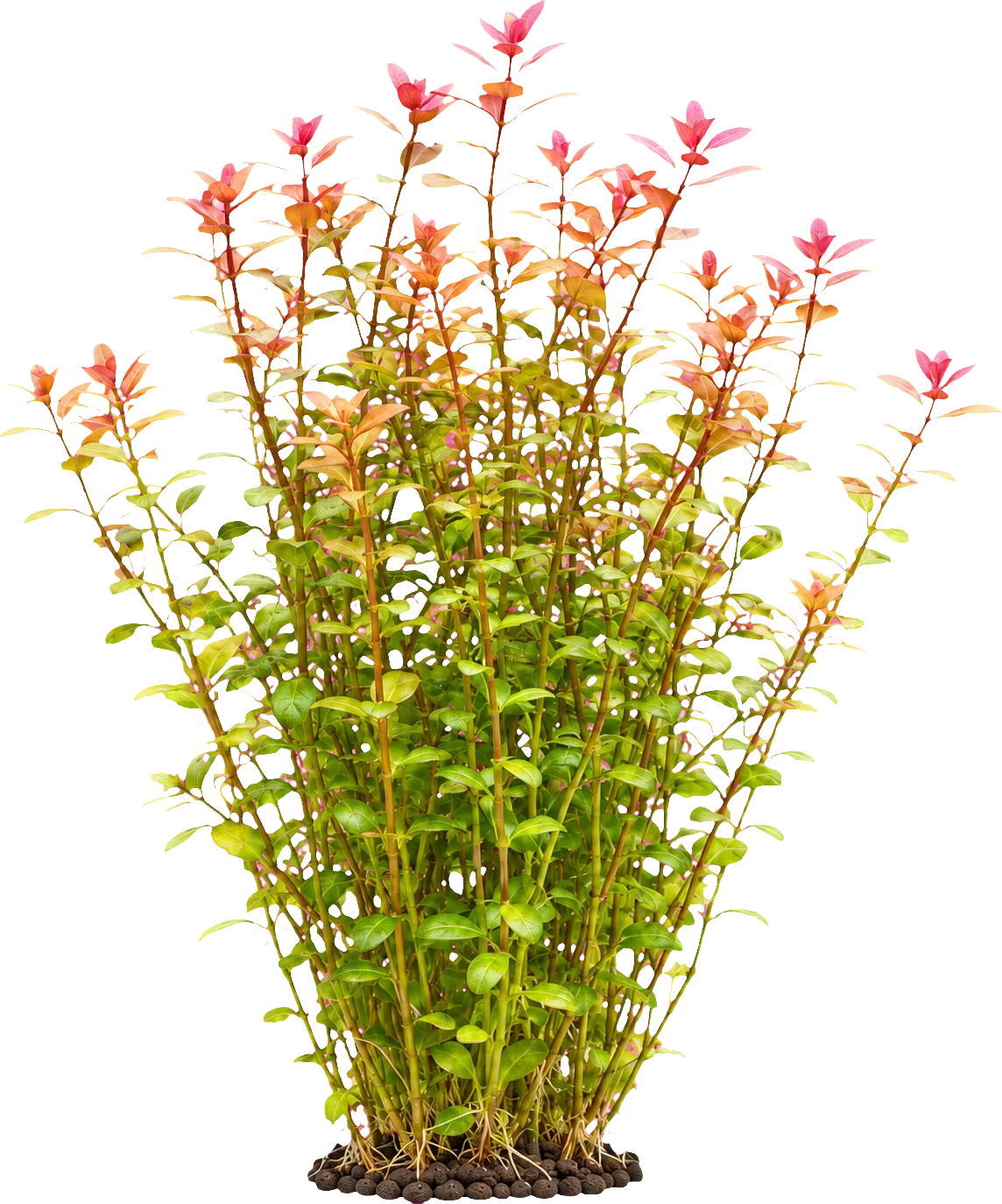
Where Round-leaf rotala comes from
Rotala rotundifolia belongs to the loosestrife family (Lythraceae) and grows wild across South and Southeast Asia, from India through Indochina and southern China to Taiwan and Japan. In nature it often creeps over wet mud along rice fields, ditches and streams, where it bears the round, fleshy, opposite leaves that give it its name. Grown fully submerged it switches to narrow, elongated leaves about 1–2 cm long, green to pinkish orange. The slender stems branch freely, can reach several tens of centimeters and grow up to the surface before bending sideways.
Growing Round-leaf rotala in a planted aquarium
In a planted aquarium this rotala tolerates medium light and keeps growing without injected CO2, but with CO2 and a nutrient-rich substrate it turns dense and the tips go clearly pink to red. It grows fast, so it suits the background or a corner of the midground, planted as a group of stems spaced slightly apart. How to grow it is simple: push single cuttings into the substrate and they root within days. Trim often, replanting the tops, and the cut stems will branch into a thick bush. Left untrimmed, the shaded lower stems lose their leaves. It is an excellent beginner plant for any aquascape.
At a glance
- Scientific name
- Rotala rotundifolia
- Light
- Medium
- CO2
- Helpful
- Growth
- Fast
- Difficulty
- Easy
- Place in a layout
- Background plants
Light, CO2 and growth are typical levels; the same plant can grow differently with each tank's light, substrate and water.
In the Nuôi Cá aquarium
In the arrange tray it sits with the background plants; at its base size it is about 25 cm tall, and you can scale it, flip it and set it nearer or deeper. Its leaves sway in the current from the filter and wave maker. Under the tank light it pearls small oxygen bubbles.
Try it in your aquarium →Sources and further reading
- GBIF — Rotala rotundifolia (scientific name, taxonomy and native range)
- OATA — freshwater aquarium care sheets (real aquarium care principles)
The "In the Nuôi Cá aquarium" part describes the 3D simulation, not real planting advice.