 Nuôi Cá
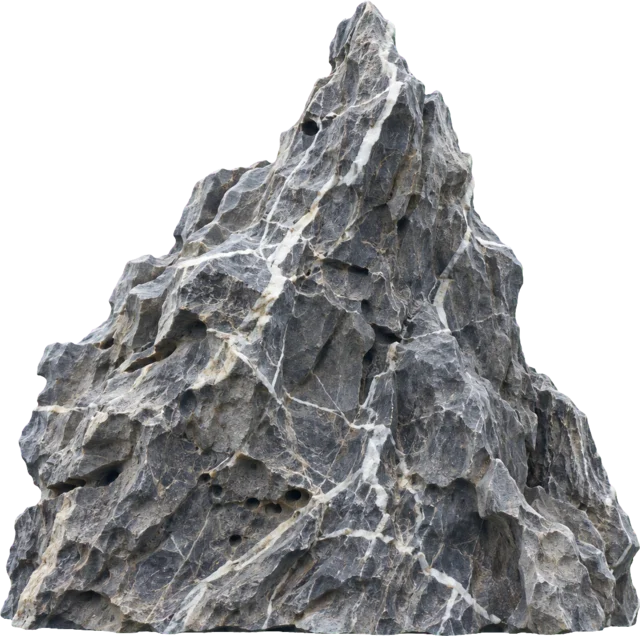
Where Large Seiryu stone comes from
Trade Seiryu stone is gray limestone with white calcite veins, mostly quarried in China; the name is borrowed from a Japanese stone. Large pieces stand 20–40 cm tall and weigh from a few to tens of kilograms, and they are scarcer and pricier because they need a good upright shape, clear veining and no cracks. In Iwagumi, the stone-based style made popular by Takashi Amano, stones are named for their role: the main Oyaishi, the secondary Fukuishi, the supporting Soeishi and the scattered Suteishi.
Large Seiryu stone in an aquascape
Place the main stone near a rule-of-thirds point, never dead center, tilted slightly toward the open space to give the scape movement. Bury about a third of its base so it is stable and seems to rise out of the ground. A big stone raises hardness and pH more than small ones, so watch KH and GH in tanks under 60 liters or with shrimp. Set heavy stones on the glass over a protective mat rather than on top of loose soil, where they can sink. The rough surface easily catches brown diatom algae in a new aquascape; nerite snails and shrimp help clean it.
At a glance
- Material
- Limestone
- Effect on water
- Raises hardness and pH
- Place in a layout
- Stones, driftwood and decor
The effect on water is what this material usually does; real stone and wood vary from batch to batch, so soak a piece and test pH and KH before it goes in the tank.
In the Nuôi Cá aquarium
In the arrange tray it sits with the stones, driftwood and decor; at its base size it is about 16 cm tall, and you can scale it, flip it and set it nearer or deeper. Shrimp and snails can climb along its top to graze.
Try it in your aquarium →Sources and further reading
- OATA — freshwater aquarium care sheets (real aquarium care principles)
The "In the Nuôi Cá aquarium" part describes the 3D simulation, not real planting advice.