 Nuôi Cá
Where Red myriophyllum comes from
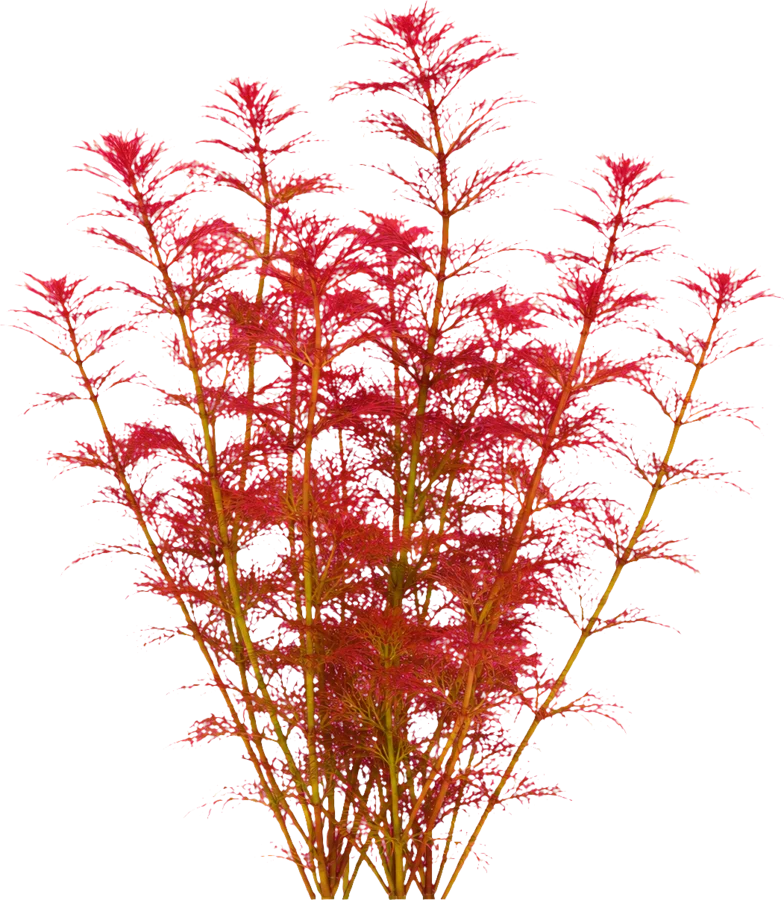
Myriophyllum tuberculatum belongs to the watermilfoil family (Haloragaceae) and is native to South and Southeast Asia, from India and Bangladesh to Thailand, growing in ponds, marshes and still, flooded fields. Leaves grow in whorls of 4–6 around the stem, each divided pinnately into many fine segments 2–3 cm long, so the whole tip looks like a plume; under strong light the plant turns pinkish to purplish red. Stems reach 50 cm or more. Names of red Myriophyllum in the trade are sometimes mixed up. Several species in the genus are serious invasive weeds, so never dump trimmings or tank water into ditches, ponds or lakes.
Growing Red myriophyllum in a planted aquarium
In a planted aquarium red myriophyllum needs strong light, steady CO2 and enough iron and micronutrients to show its red; lacking any of these, it fades to brownish green, the tips shrink and leaves drop. In good conditions it grows very fast and suits dense groups in the background of an aquascape. How to grow it: set stems individually with tweezers a few centimeters apart. Trim and replant the tops often, discarding weak bases. The very fine leaves trap dust, algae and debris when flow is weak, and plant-eating fish pick at them. It reacts to changes in water parameters, so care is hard and best for experienced keepers.
At a glance
- Scientific name
- Myriophyllum tuberculatum
- Light
- High
- CO2
- Required
- Growth
- Fast
- Difficulty
- Demanding
- Place in a layout
- Background plants
Light, CO2 and growth are typical levels; the same plant can grow differently with each tank's light, substrate and water.
In the Nuôi Cá aquarium
In the arrange tray it sits with the background plants; at its base size it is about 27 cm tall, and you can scale it, flip it and set it nearer or deeper. Its leaves sway in the current from the filter and wave maker. Under the tank light it pearls small oxygen bubbles. It opens in the tray on day 6 of your visits.
Try it in your aquarium →Sources and further reading
- GBIF — Myriophyllum tuberculatum (scientific name, taxonomy and native range)
- OATA — freshwater aquarium care sheets (real aquarium care principles)
The "In the Nuôi Cá aquarium" part describes the 3D simulation, not real planting advice.