 Nuôi Cá
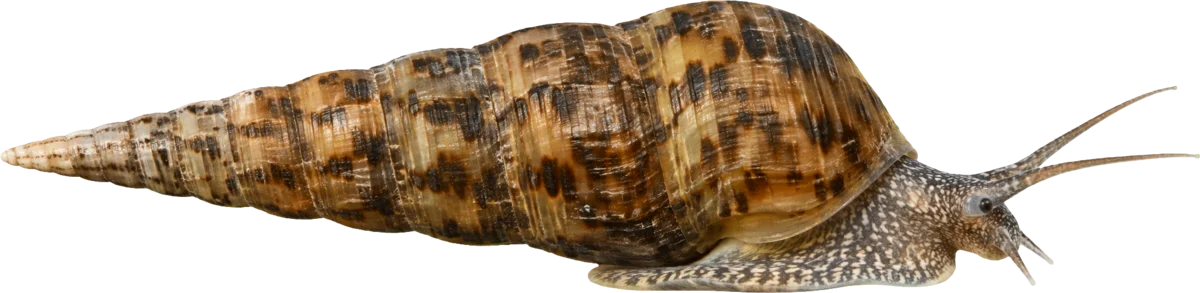
Malaysian trumpet snail in the wild
Melanoides tuberculata is native to Africa and southern Asia and has spread throughout the tropics, becoming invasive in many places. Its pointed 2–3 cm shell is brown with darker flecks. It stays buried in mud and sand by day and comes out at night. It bears live young and can reproduce without males (parthenogenesis), so populations grow very quickly.
Keeping Malaysian trumpet snail in a planted aquarium
In a planted aquarium it constantly burrows through the substrate, keeping it from compacting and going anaerobic, and cleans up food that sinks to the bottom. It hardly ever harms plants. The downside is a population boom when food is plentiful; many snails on the glass by day signal excess food or poor water. Feed less or add assassin snails to reduce numbers. Never release it into natural waters.
Water values are typical ranges; check with the seller for the exact species and line you buy, and acclimatise new animals slowly.
Classification
- Scientific name
- Melanoides tuberculata
- Family
- Thiaridae (thiarid snails)
- Adult size
- 2–3 cm
- Food
- Leftovers, dead leaves, algae
Trade names and colour lines may differ from the scientific name; many colour lines belong to one species.
In the Nuôi Cá aquarium
In the 3D aquarium the snail crawls slowly over substrate, stone and wood looking for food, and withdraws into its shell when touched. It opens in the farm on day 3 of your visits to the tank.
Temperament: A pointed shell like a little horn; buries itself by day and comes up at night, loosening the gravel for plant roots.
Add it to your aquarium →Sources and further reading
- GBIF — Melanoides tuberculata (scientific name, taxonomy and distribution)
- OATA — freshwater aquarium care sheets (real aquarium care principles)
The "In the Nuôi Cá aquarium" part describes the 3D simulation; its stocking limits are not real-world care instructions.