 Nuôi Cá
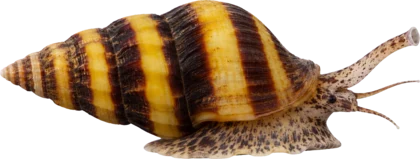
Assassin snail in the wild
Anentome helena lives in rivers and lakes of Southeast Asia (Thailand, Malaysia, Indonesia, Laos). Its pointed 2–3 cm shell carries alternating yellow and dark brown bands. It is a predator that eats other small snails and carrion, often waiting buried in the substrate. The sexes are separate and it lays single eggs in tough capsules on stone and wood, so it breeds slowly.
Keeping Assassin snail in a planted aquarium
In an aquarium it is a biological way to reduce pest snails such as trumpet or bladder snails when they multiply. Remember it also eats small ornamental snails (ramshorns, mini nerites), so do not combine it with those you want to keep. Adult shrimp are usually safe. It prefers sand or fine gravel to burrow in; when the prey snails are gone, add protein-rich sinking food. Never release it into the wild.
Water values are typical ranges; check with the seller for the exact species and line you buy, and acclimatise new animals slowly.
Classification
- Scientific name
- Anentome helena
- Family
- Nassariidae (nassa snails)
- Adult size
- 2–3 cm
- Food
- Small snails, protein-rich sinking pellets
Trade names and colour lines may differ from the scientific name; many colour lines belong to one species.
In the Nuôi Cá aquarium
In the 3D aquarium the snail crawls slowly over substrate, stone and wood looking for food, and withdraws into its shell when touched.
Temperament: Yellow-and-brown striped shell; buries itself in the substrate and hunts pest snails.
Add it to your aquarium →Sources and further reading
- GBIF — Anentome helena (scientific name, taxonomy and distribution)
- OATA — freshwater aquarium care sheets (real aquarium care principles)
The "In the Nuôi Cá aquarium" part describes the 3D simulation; its stocking limits are not real-world care instructions.