 Nuôi Cá
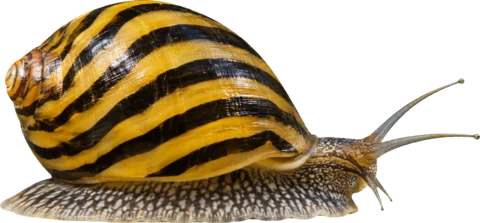
Zebra nerite snail in the wild
Neritina natalensis lives in rivers, streams and estuaries along the coast of East Africa, from South Africa to Kenya. Its rounded shell, about 2–3 cm, carries black stripes on olive-yellow; it seals itself in with a hard operculum when threatened. It lays small white eggs on stone, wood and glass; they do not hatch in fresh water because the larvae need brackish water, so the snail never overruns the tank. The eggs are tough and can be scraped off if they spoil the look.
Keeping Zebra nerite snail in a planted aquarium
In a planted aquarium the nerite is one of the best algae-eating snails: it roams over glass, stone, wood and leaves, grazing film and green spot algae without eating healthy plants. It needs mineral-rich water (moderate hardness, pH 7 or above) to keep its shell from eroding, and a lid or a water line below the rim, since nerites sometimes crawl out. Once the algae is gone, add algae wafers or blanched vegetables.
Water values are typical ranges; check with the seller for the exact species and line you buy, and acclimatise new animals slowly.
Classification
- Scientific name
- Neritina natalensis
- Family
- Neritidae (nerite snails)
- Adult size
- 2–3 cm
- Food
- Algae on glass, stone and driftwood
Trade names and colour lines may differ from the scientific name; many colour lines belong to one species.
In the Nuôi Cá aquarium
In the 3D aquarium the snail crawls over substrate, stone and wood, then climbs the back glass, the side panes and sometimes the front glass to graze algae; through the front glass you see its foot, on the back glass only its shell. It helps slow the algae on the glass.
Temperament: Crawls the glass cleaning off algae; withdraws into its shell when touched. Does not breed in fresh water.
Add it to your aquarium →Sources and further reading
- GBIF — Neritina natalensis (scientific name, taxonomy and distribution)
- OATA — freshwater aquarium care sheets (real aquarium care principles)
The "In the Nuôi Cá aquarium" part describes the 3D simulation; its stocking limits are not real-world care instructions.