 Nuôi Cá
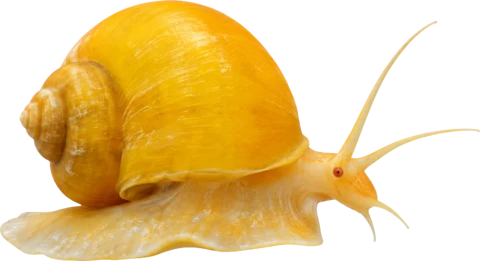
Golden mystery snail in the wild
Pomacea bridgesii comes from the Amazon basin (Brazil, Bolivia, Peru), living in warm ponds, marshes and slow canals. The shell can reach 5–6 cm; wild snails are banded brown and the gold form is selectively bred. In shops it is often confused with Pomacea diffusa (usually sold as the mystery snail), which looks very similar. Apple snails (Ampullariidae) have both a gill and a lung and stretch a breathing tube (siphon) up to the surface for air. The sexes are separate, and they lay pale pink egg clutches on the glass or lid above the water line; remove the clutch if you do not want young snails.
Keeping Golden mystery snail in a planted aquarium
In an aquarium apple snails clean up leftovers on the substrate but produce a fair amount of waste, so they need good filtration and room (a few tens of litres per snail). Leave an air gap between the water and the lid for breathing, keep the water at 22–27 °C with pH 7 or above, and provide calcium for a strong shell. Avoid fish that nip tentacles, such as puffers and some cichlids. Hungry apple snails may nibble soft plants, so feed enough sinking food and blanched vegetables in a heavily planted tank.
Water values are typical ranges; check with the seller for the exact species and line you buy, and acclimatise new animals slowly.
Classification
- Scientific name
- Pomacea bridgesii
- Family
- Ampullariidae (apple snails)
- Adult size
- 4–6 cm
- Food
- Leftovers, algae wafers, blanched vegetables
Trade names and colour lines may differ from the scientific name; many colour lines belong to one species.
In the Nuôi Cá aquarium
In the 3D aquarium the snail crawls slowly over substrate, stone and wood looking for food, and withdraws into its shell when touched.
Temperament: Peaceful, eats leftovers on the substrate and raises its breathing tube to the surface.
Add it to your aquarium →Sources and further reading
- GBIF — Pomacea bridgesii (scientific name, taxonomy and distribution)
- OATA — freshwater aquarium care sheets (real aquarium care principles)
The "In the Nuôi Cá aquarium" part describes the 3D simulation; its stocking limits are not real-world care instructions.