 Nuôi Cá
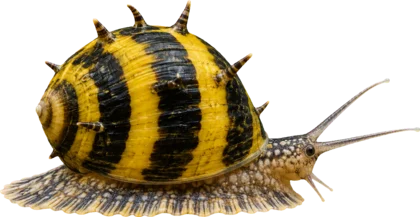
Horned nerite snail in the wild
Clithon corona lives in coastal streams and estuaries of the Indo-West Pacific (Indonesia, the Philippines, Papua New Guinea). Its shell is only about 1–1.5 cm, with short spines that deter predators; the number of spines and the banding vary between individuals. It lays small white eggs on stone, wood and glass; they do not hatch in fresh water because the larvae need brackish water, so the snail never overruns the tank. The eggs are tough and can be scraped off if they spoil the look.
Keeping Horned nerite snail in a planted aquarium
Its small size lets it get into rock crevices, moss and between leaves to graze algae, which makes it a great fit for nano planted tanks and shrimp tanks. It needs mineral-rich water (moderate hardness, pH 7 or above) to keep its shell from eroding, and a lid or a water line below the rim, since nerites sometimes crawl out. Once the algae is gone, add algae wafers or blanched vegetables.
Water values are typical ranges; check with the seller for the exact species and line you buy, and acclimatise new animals slowly.
Classification
- Scientific name
- Clithon corona
- Family
- Neritidae (nerite snails)
- Adult size
- 1–2 cm
- Food
- Algae
Trade names and colour lines may differ from the scientific name; many colour lines belong to one species.
In the Nuôi Cá aquarium
In the 3D aquarium the snail crawls over substrate, stone and wood, then climbs the back glass, the side panes and sometimes the front glass to graze algae; through the front glass you see its foot, on the back glass only its shell. It helps slow the algae on the glass. It opens in the farm on day 4 of your visits to the tank.
Temperament: A banded black-and-yellow shell with a crown of short spines; cleans algae off glass and stone, never breeds in fresh water.
Add it to your aquarium →Sources and further reading
- GBIF — Clithon corona (scientific name, taxonomy and distribution)
- OATA — freshwater aquarium care sheets (real aquarium care principles)
The "In the Nuôi Cá aquarium" part describes the 3D simulation; its stocking limits are not real-world care instructions.