 Nuôi Cá
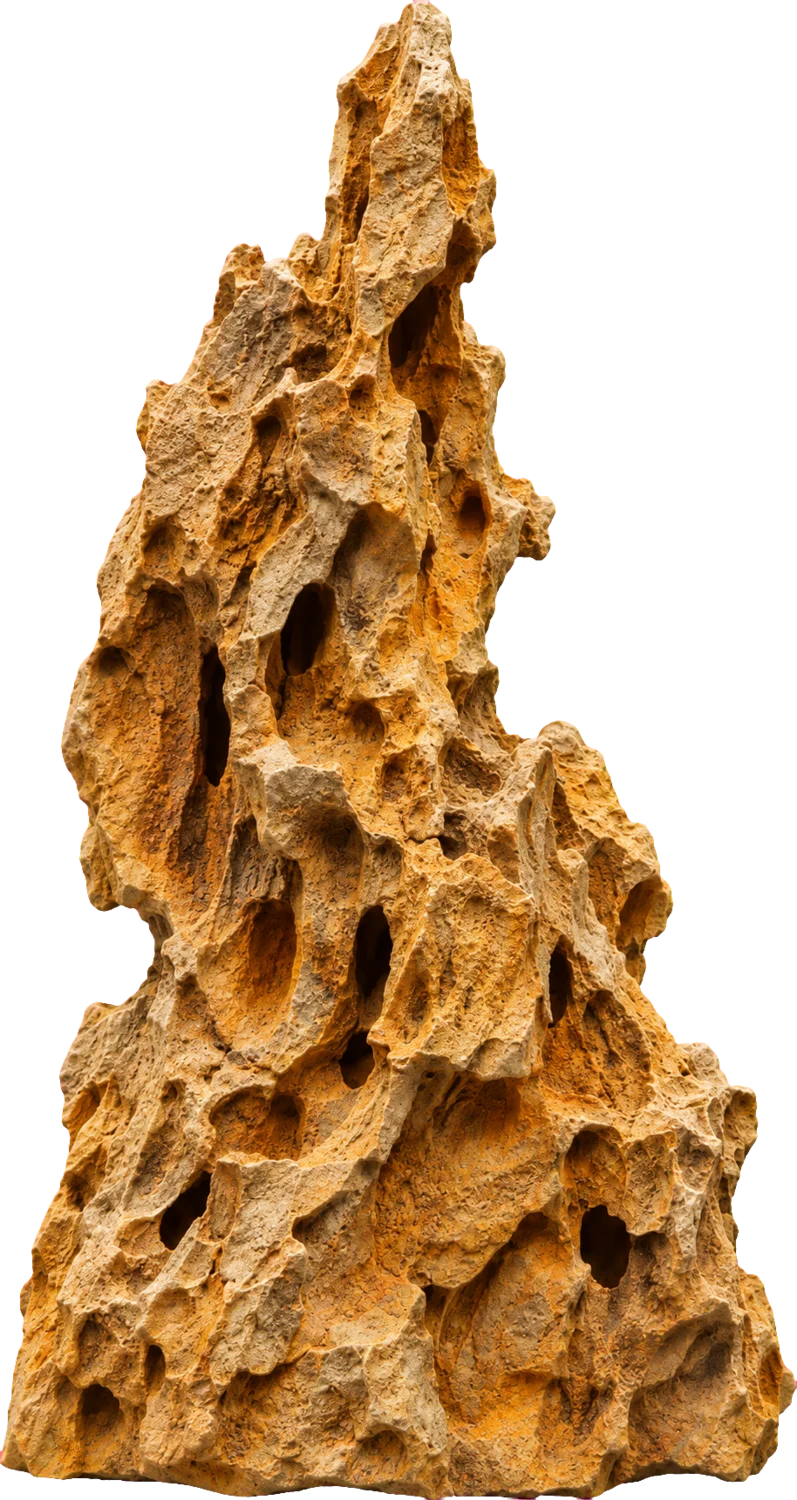
Where Upright Ohko stone comes from
Ohko is a trade name for a stone mostly from China, and what it is geologically is debated. It is usually described as a hardened clay or claystone, sometimes as a kind of sedimentary breccia, with a yellow-brown to orange-brown crust, a gray core and countless honeycomb holes where softer material weathered out. It is fairly light for its size, brittle and easy to break into pieces with natural edges. The holes often still hold clay and mud when the stone is bought.
Upright Ohko stone in an aquascape
Dragon stone is generally considered inert, with little or no effect on pH or hardness, so it suits soft-water shrimp tanks; still, test the water for the first weeks. Scrub and hose out the clay in the holes before use or the water stays cloudy. Use upright pieces as main stones, chip the base flat so they stand, and bury part of it in the substrate. The holes are ready-made spots for moss, Bucephalandra or small anubias and shelter for shrimp and small fish. The stone is brittle, so glue stacked pieces. Edges can be sharp for long-finned fish. Easy to use.
At a glance
- Material
- Hardened claystone
- Effect on water
- Inert: leaves the water chemistry alone
- Place in a layout
- Stones, driftwood and decor
The effect on water is what this material usually does; real stone and wood vary from batch to batch, so soak a piece and test pH and KH before it goes in the tank.
In the Nuôi Cá aquarium
In the arrange tray it sits with the stones, driftwood and decor; at its base size it is about 18 cm tall, and you can scale it, flip it and set it nearer or deeper. Shrimp and snails can climb along its top to graze.
Try it in your aquarium →Sources and further reading
- OATA — freshwater aquarium care sheets (real aquarium care principles)
The "In the Nuôi Cá aquarium" part describes the 3D simulation, not real planting advice.