 Nuôi Cá
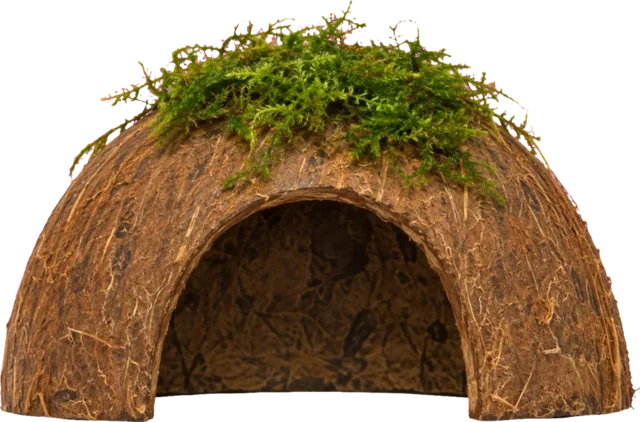
Where Coconut cave comes from
The shell is the hard endocarp of the coconut (Cocos nucifera, palm family Arecaceae), a tropical palm grown along coasts across Asia, the Pacific and Vietnam. After the flesh is removed, the shell is scraped free of husk fibers, sawn in half and given a cut-out entrance. It is hard, durable, light and dark brown, and essentially a cheap by-product. The moss covering is made by tying Java moss, Christmas moss or weeping moss over the back of the shell, which grips and fills in over a few weeks.
Coconut cave in an aquascape
Scrape off all fiber and leftover flesh from a new shell, then boil it for about 10–20 minutes to sterilize it and help it sink; for the first weeks it may release a little tannin and tint the water slightly, after which it is close to inert. Set it in the foreground or midground with the entrance facing forward or sideways, partly buried for a natural look. It is a favorite spawning cave for Apistogramma, bettas and shrimp. The moss needs low to medium light and regular trimming. A shell lasts for years; replace it if it turns soft or moldy. Easy to use.
At a glance
- Material
- Coconut shell
- Effect on water
- Inert: leaves the water chemistry alone
- Place in a layout
- Stones, driftwood and decor
The effect on water is what this material usually does; real stone and wood vary from batch to batch, so soak a piece and test pH and KH before it goes in the tank.
In the Nuôi Cá aquarium
In the arrange tray it sits with the stones, driftwood and decor; at its base size it is about 10 cm wide, and you can scale it, flip it and set it nearer or deeper. Shrimp and snails can climb along its top to graze.
Try it in your aquarium →Sources and further reading
- OATA — freshwater aquarium care sheets (real aquarium care principles)
The "In the Nuôi Cá aquarium" part describes the 3D simulation, not real planting advice.