 Nuôi Cá
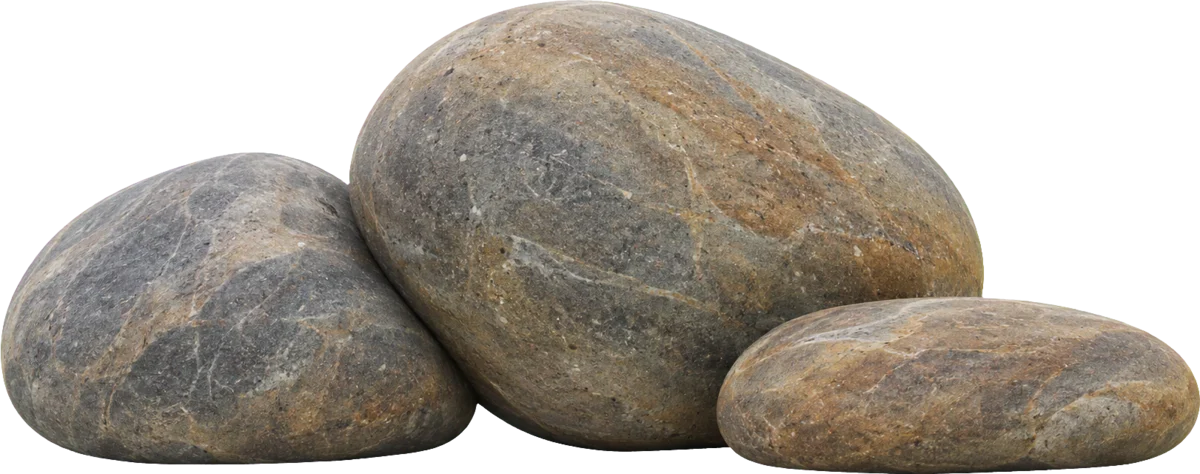
Where River boulder trio comes from
River stones are pieces of granite, greenstone or other hard rock that rivers rolled for thousands of years until they turned round and polished, with natural grey, brown and ochre veins and speckles. Keepers pick or buy single stones from river banks and set them as a group of three: a large one in the middle, a medium one and a small flat one in front, the odd-numbered arrangement familiar from aquascape layouts. The whole group is usually 30 to 50 cm wide and very heavy.
River boulder trio in an aquascape
River stone is inert and does not change pH or hardness, so it suits any fish tank. For big fish, rounded stones are safer than sharp lava rock or Seiryu stone: an arowana that bumps them when startled is not scratched, and a digging flowerhorn struggles to topple them. Set the group straight on the bottom glass (over a mat) before adding sand, the largest stone at the back and the others leaning firmly against it. The smooth surfaces are hard to tie plants to, so leave them bare or plant anubias or bucephalandra in the gaps between the stones. Rinse well without soap; stones taken from a stream should be soaked and scrubbed. Easy to use.
At a glance
- Material
- River stone (granite, greenstone)
- Effect on water
- Inert: leaves the water chemistry alone
- Place in a layout
- Stones, driftwood and decor
The effect on water is what this material usually does; real stone and wood vary from batch to batch, so soak a piece and test pH and KH before it goes in the tank.
In the Nuôi Cá aquarium
In the arrange tray it sits with the stones, driftwood and decor; at its base size it is about 31 cm wide, and you can scale it, flip it and set it nearer or deeper. Shrimp and snails can climb along its top to graze.
Try it in your aquarium →Sources and further reading
- OATA — freshwater aquarium care sheets (real aquarium care principles)
The "In the Nuôi Cá aquarium" part describes the 3D simulation, not real planting advice.