 Nuôi Cá
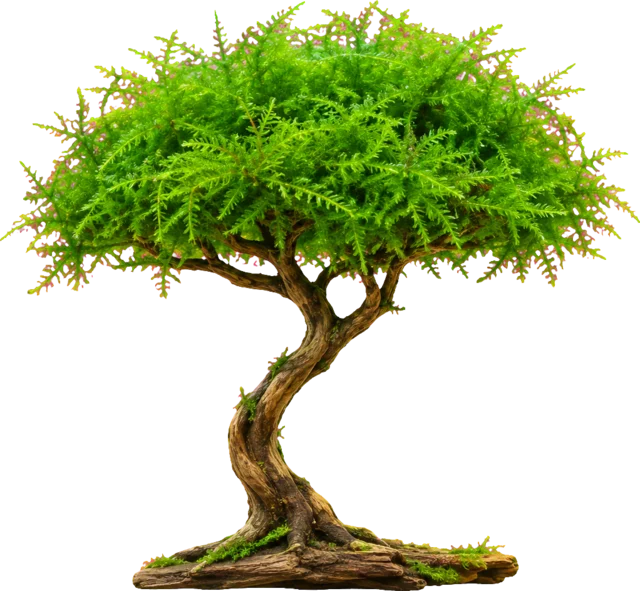
Where Moss tree comes from
A moss tree is not a plant species but an aquascaping technique: thin pieces of driftwood, often twiggy branch wood, shrub roots or "spider wood", are assembled into a trunk and branches, and moss is tied to the tips to form the canopy. The usual moss is Christmas moss (Vesicularia montagnei), a true moss in the family Hypnaceae from tropical Asia whose branches lie in tiers like fir needles; Java moss or flame moss are also used. In time the moss grows over the ties and fills out into a natural green crown.
Growing Moss tree in a planted aquarium
To make one, spread the moss very thinly over the branch tips, tie it on with fishing line or fix it with cyanoacrylate glue, and anchor the base to a stone or the substrate so the wood cannot float. Christmas moss needs medium light; CO2 and cool, clean water give a denser, more tiered crown. The moss grows slowly, so the canopy takes months to close. Trim it evenly and siphon out trapped debris, or the inside rots and hair algae moves in. New wood may release tannins that tint the water amber for a while. Moderate care, mostly a matter of patient trimming.
At a glance
- Light
- Medium
- CO2
- Helpful
- Growth
- Slow
- Difficulty
- Moderate
- Place in a layout
- Aquarium mosses
Light, CO2 and growth are typical levels; the same plant can grow differently with each tank's light, substrate and water.
In the Nuôi Cá aquarium
In the arrange tray it sits with the aquarium mosses; at its base size it is about 16 cm tall, and you can scale it, flip it and set it nearer or deeper. Moss is placed freely, usually on stone or wood, just as real moss is tied on. Under the tank light it pearls small oxygen bubbles.
Try it in your aquarium →Sources and further reading
- OATA — freshwater aquarium care sheets (real aquarium care principles)
The "In the Nuôi Cá aquarium" part describes the 3D simulation, not real planting advice.