 Nuôi Cá
Where Java moss comes from
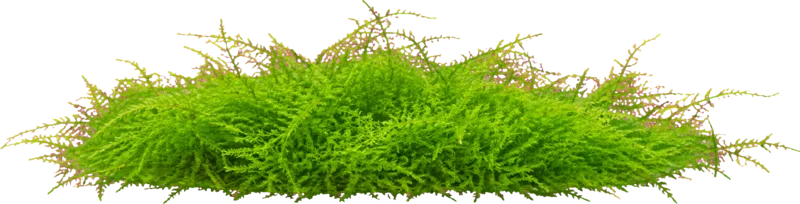
Java moss is a true moss from Southeast Asia, where it grows on rocks, tree roots and damp banks along tropical streams and rivers. Its scientific identity in the trade is still debated: long sold as Vesicularia dubyana, it is now usually identified as Taxiphyllum barbieri in the family Hypnaceae. Like all mosses it has no true roots and clings with fine rhizoids. The thin stems branch irregularly and carry tiny leaves only about 1–2 mm long, forming tangled, trailing clumps.
Growing Java moss in a planted aquarium
Java moss survives in almost any tank: low light, no CO2 and a wide range of temperature and hardness. More light and CO2 simply make it denser and greener. To grow it, spread a thin layer over wood or rock and tie it on with fishing line or fix it with cyanoacrylate glue; within a few weeks it attaches by itself. It grows fairly fast and untidily, so trim it regularly to keep a shape and stop the inner layers rotting. The mats trap debris and hair algae, so gentle flow helps. Shrimp and fry graze and hide in it. Very easy care.
At a glance
- Scientific name
- Taxiphyllum barbieri
- Light
- Low
- CO2
- Not needed
- Growth
- Medium
- Difficulty
- Easy
- Place in a layout
- Aquarium mosses
Light, CO2 and growth are typical levels; the same plant can grow differently with each tank's light, substrate and water.
In the Nuôi Cá aquarium
In the arrange tray it sits with the aquarium mosses; at its base size it is about 17 cm wide, and you can scale it, flip it and set it nearer or deeper. Moss is placed freely, usually on stone or wood, just as real moss is tied on.
Try it in your aquarium →Sources and further reading
- GBIF — Taxiphyllum barbieri (scientific name, taxonomy and native range)
- OATA — freshwater aquarium care sheets (real aquarium care principles)
The "In the Nuôi Cá aquarium" part describes the 3D simulation, not real planting advice.