 Nuôi Cá
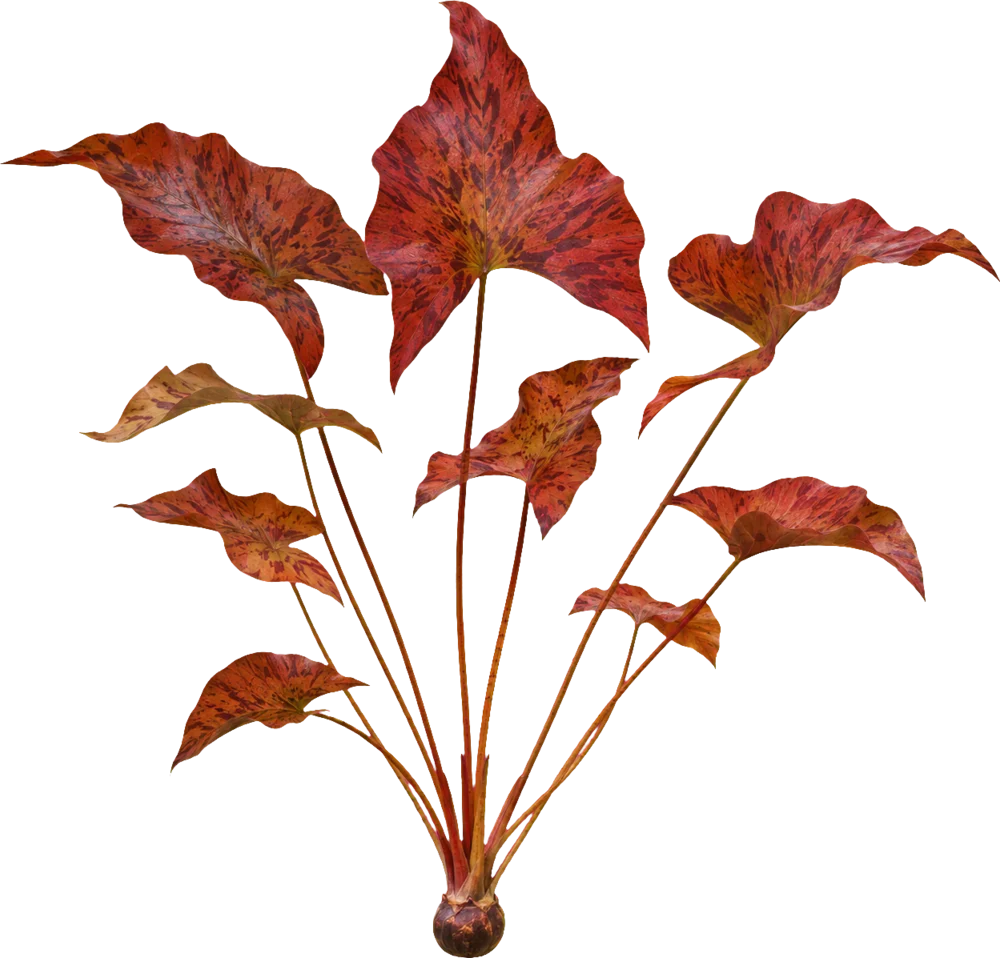
Where Red tiger lotus comes from
Red tiger lotus belongs to the water lily family (Nymphaeaceae). The red aquarium form is usually identified as Nymphaea zenkeri, native to West and Central Africa (often given as Cameroon), where it grows in rivers, streams and shallow water; plants in the trade are still often labeled Nymphaea lotus, a name that properly belongs to the green tiger lotus. It grows from a bulb, with rounded heart-shaped submerged leaves about 10 to 20 cm long, purple-red to reddish brown with darker mottling, and later sends up long stalks with floating pads and can bear white night-opening flowers. A single plant can spread 30 to 50 cm across.
Growing Red tiger lotus in a planted aquarium
In a planted aquarium red tiger lotus needs medium light, and CO2 gives larger, deeper-colored leaves. How to grow it: press the lower half of the bulb into the substrate with the top showing, never bury it fully or it may rot; it is a heavy root feeder, so use a nutrient substrate or root tabs. It grows fast and tall, usually placed in the midground or as a single focal plant. To keep low, attractive submerged leaves, cut off each leaf stalk heading for the surface, since floating pads shade the whole tank. It produces daughter plants from the bulb and runners, which can be separated. A new bulb may sit dormant for weeks before sprouting, and digging fish can uproot it before it roots.
At a glance
- Scientific name
- Nymphaea zenkeri
- Light
- Medium
- CO2
- Helpful
- Growth
- Fast
- Difficulty
- Easy
- Place in a layout
- Midground plants
Light, CO2 and growth are typical levels; the same plant can grow differently with each tank's light, substrate and water.
In the Nuôi Cá aquarium
In the arrange tray it sits with the midground plants; at its base size it is about 18 cm tall, and you can scale it, flip it and set it nearer or deeper. Its leaves sway in the current from the filter and wave maker. Under the tank light it pearls small oxygen bubbles.
Try it in your aquarium →Sources and further reading
- GBIF — Nymphaea zenkeri (scientific name, taxonomy and native range)
- OATA — freshwater aquarium care sheets (real aquarium care principles)
The "In the Nuôi Cá aquarium" part describes the 3D simulation, not real planting advice.