 Nuôi Cá
Where Bucephalandra comes from
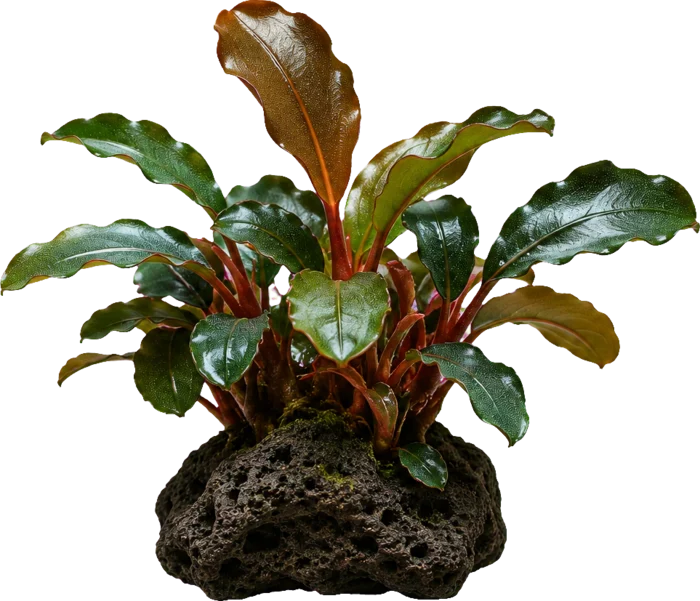
Bucephalandra is a genus in the arum family (Araceae), endemic to Borneo (Malaysia, Indonesia and Brunei). In the wild it is a rheophyte, clinging to rocks in fast forest streams and spending part of the year submerged and part exposed. It has a creeping rhizome and thick lance-shaped leaves about 2 to 10 cm long depending on the form, in green, brown, purple or metallic blue-green, many with white speckles. Many trade names such as Kedagang, Brownie or Wavy Green are just locality or sales names, and plenty of forms are not formally described. Heavy wild collection has raised concern, so tissue-cultured or tank-propagated plants are the better choice.
Growing Bucephalandra in a planted aquarium
In a planted aquarium Bucep does well in low to medium light without CO2, though CO2 speeds up new leaves and improves color. Growth is very slow, often only a few leaves a month. How to grow it: never bury the rhizome, which tends to rot; tie it with thread or glue it to stone, driftwood or crevices in the midground and foreground, and the roots grip within weeks. Propagate by cutting the rhizome into pieces with a few leaves each. Because the leaves live long and grow slowly, they easily collect algae and diatoms, so give it gentle flow and avoid very strong light in a lightly planted fish tank. It tolerates a wide range of pH and hardness and is very easy to keep.
At a glance
- Scientific name
- Bucephalandra sp.
- Light
- Low
- CO2
- Not needed
- Growth
- Slow
- Difficulty
- Easy
- Place in a layout
- Midground plants
Light, CO2 and growth are typical levels; the same plant can grow differently with each tank's light, substrate and water.
In the Nuôi Cá aquarium
In the arrange tray it sits with the midground plants; at its base size it is about 10 cm tall, and you can scale it, flip it and set it nearer or deeper. Its leaves sway in the current from the filter and wave maker.
Try it in your aquarium →Sources and further reading
- GBIF — Bucephalandra sp. (scientific name, taxonomy and native range)
- OATA — freshwater aquarium care sheets (real aquarium care principles)
The "In the Nuôi Cá aquarium" part describes the 3D simulation, not real planting advice.