 Nuôi Cá
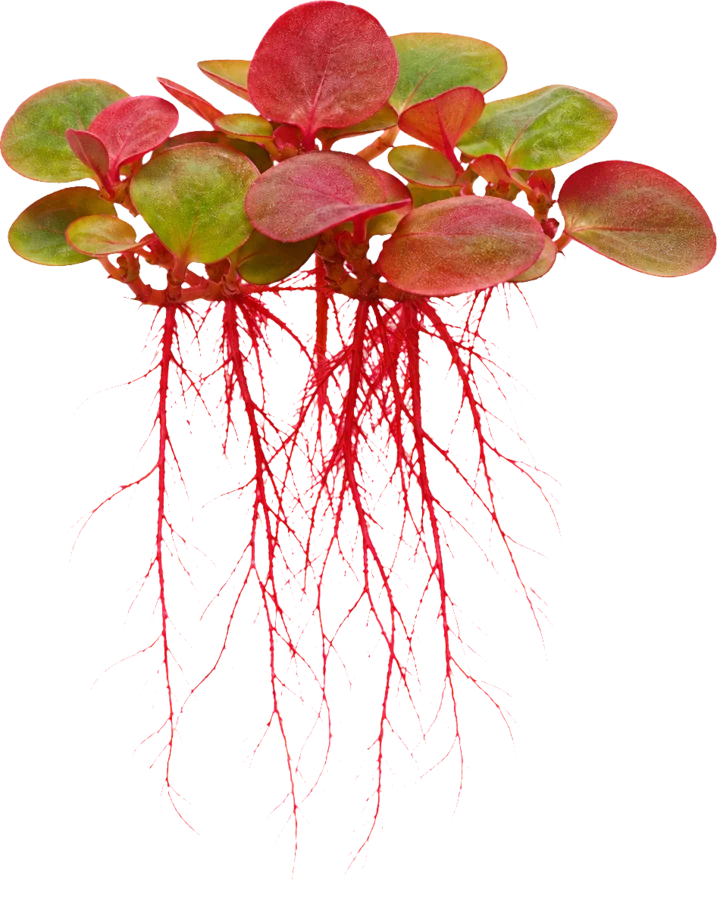
Where Red root floater comes from
Phyllanthus fluitans belongs to the leafflower family (Phyllanthaceae) and is one of very few aquatic species in a genus otherwise made of land plants. It is native to the Amazon basin and nearby parts of South America, including Peru, Brazil, Colombia and Venezuela, where it floats on still backwaters and flooded lakes. The round, cupped leaves are about 1–1.5 cm across, alternate along short stems, with air pockets underneath that keep them afloat; the short, fine, hairy roots are red. It bears tiny white flowers. Like any floating plant, it should never be released into the wild.
Growing Red root floater in a planted aquarium
In a fish tank red root floater survives in medium light and needs no added CO2, since it takes carbon dioxide from the air; for bright red leaves and roots it wants strong light, enough iron and low nitrate. Growth is moderate, covering part of the surface, giving fish light shade and taking up spare nutrients. It dislikes strong surface agitation and water sitting on its leaves, so keep surface flow gentle and the lid ventilated; leaves that stay wet will rot. Thin it out when it gets crowded. Nutrient shortage gives small, yellowing leaves. Care in a planted aquarium is moderate.
At a glance
- Scientific name
- Phyllanthus fluitans
- Light
- Medium
- CO2
- Not needed
- Growth
- Medium
- Difficulty
- Moderate
- Place in a layout
- Floating plants
Light, CO2 and growth are typical levels; the same plant can grow differently with each tank's light, substrate and water.
In the Nuôi Cá aquarium
In the arrange tray it sits with the floating plants; at its base size it is about 28 cm wide, and you can scale it, flip it and set it nearer or deeper. It floats on the surface and drifts gently with the current. It opens in the tray on day 4 of your visits.
Try it in your aquarium →Sources and further reading
- GBIF — Phyllanthus fluitans (scientific name, taxonomy and native range)
- OATA — freshwater aquarium care sheets (real aquarium care principles)
The "In the Nuôi Cá aquarium" part describes the 3D simulation, not real planting advice.