 Nuôi Cá
Where Amazon frogbit comes from
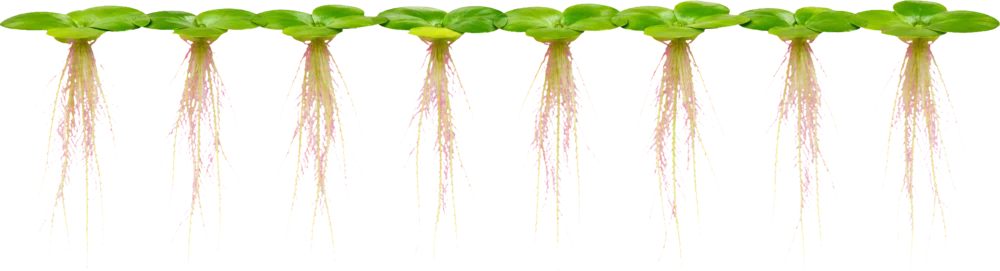
Limnobium laevigatum, Amazon frogbit, belongs to the frogbit family (Hydrocharitaceae) and is native to Central and South America, from Mexico to Argentina, where it floats on ponds, marshes and slow rivers. It forms small rosettes of round to heart-shaped leaves 1–3 cm across; young leaves have a spongy, air-filled layer underneath that keeps them afloat. The white, finely hairy roots can grow longer than 10 cm. It spreads quickly through runners that bud off daughter plants. It has become invasive in California, Japan, Zimbabwe and elsewhere, so never release frogbit or pour tank water containing it into ponds, lakes or waterways.
Growing Amazon frogbit in a planted aquarium
In a fish tank Amazon frogbit needs only medium light and no added CO2, since it takes carbon dioxide straight from the air, and it grows fast on nitrate and phosphate in the water, making it a strong ally against algae. It gives shade and cover for shy fish, bubble-nesting species and baby shrimp. Remove some every week so it covers only part of the surface, because a full mat starves the planted aquarium below of light. The leaves rot if splashed or dripped on by condensation from a lid, and it dislikes strong surface flow. Overlong roots can be trimmed. Yellowing usually means iron or potassium shortage. Care is easy.
At a glance
- Scientific name
- Limnobium laevigatum
- Light
- Medium
- CO2
- Not needed
- Growth
- Fast
- Difficulty
- Easy
- Place in a layout
- Floating plants
Light, CO2 and growth are typical levels; the same plant can grow differently with each tank's light, substrate and water.
In the Nuôi Cá aquarium
In the arrange tray it sits with the floating plants; at its base size it is about 32 cm wide, and you can scale it, flip it and set it nearer or deeper. It floats on the surface and drifts gently with the current.
Try it in your aquarium →Sources and further reading
- GBIF — Limnobium laevigatum (scientific name, taxonomy and native range)
- OATA — freshwater aquarium care sheets (real aquarium care principles)
The "In the Nuôi Cá aquarium" part describes the 3D simulation, not real planting advice.