 Nuôi Cá
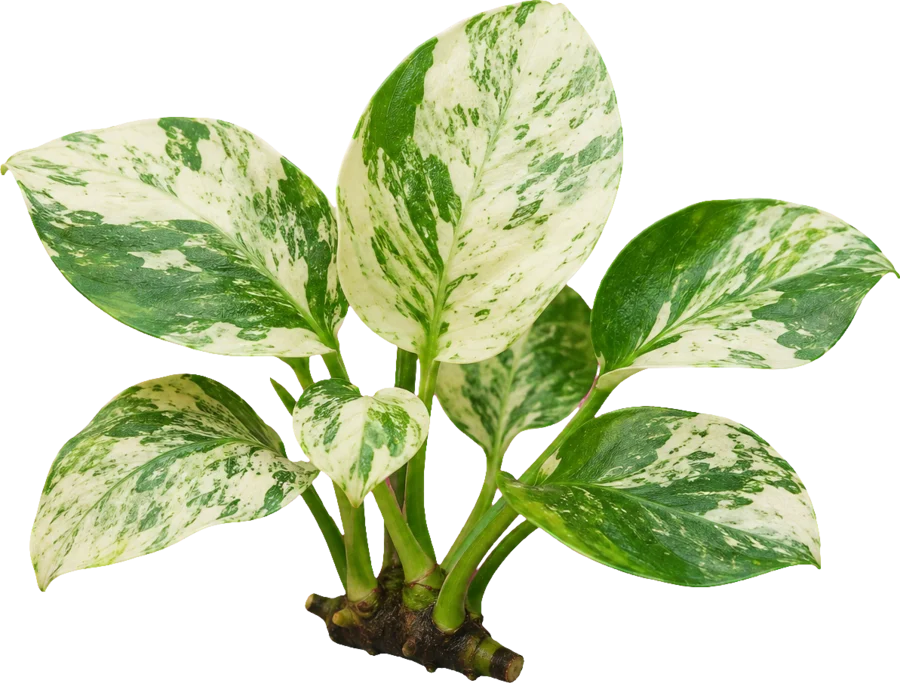
Where Anubias Pinto comes from
'Pinto' is a selected form of Anubias barteri, an arum (Araceae) native to West Africa. It is a variegation that appeared in cultivation, usually in the small-leaved nana group, and has since been multiplied by tissue culture; the amount of white varies from plant to plant, and new leaves can come out fully green or almost all white. It has a creeping rhizome and thick oval leaves about 3 to 6 cm long with white to cream streaks and speckles on dark green, the whole plant roughly 5 to 10 cm tall.
Growing Anubias Pinto in a planted aquarium
In a planted aquarium Anubias Pinto is kept like Anubias nana: low to medium light, no CO2, and the rhizome tied or glued to stone or driftwood in the foreground or midground rather than buried. Because the white parts lack chlorophyll, it grows even more slowly than green Anubias, and the white patches brown or collect algae under harsh light, so give it a shaded spot with gentle flow. Propagate by cutting the rhizome once it is long enough, keeping divisions that carry both green and white leaves, since a fully white plant cannot feed itself. Plant-eating fish leave it alone. It is not demanding, but its slow growth and sensitivity to algae make it a medium-difficulty plant.
At a glance
- Scientific name
- Anubias barteri 'Pinto'
- Light
- Low
- CO2
- Not needed
- Growth
- Slow
- Difficulty
- Moderate
- Place in a layout
- Midground plants
Light, CO2 and growth are typical levels; the same plant can grow differently with each tank's light, substrate and water.
In the Nuôi Cá aquarium
In the arrange tray it sits with the midground plants; at its base size it is about 12 cm wide, and you can scale it, flip it and set it nearer or deeper. Its leaves sway in the current from the filter and wave maker. It opens in the tray on day 3 of your visits.
Try it in your aquarium →Sources and further reading
- GBIF — Anubias barteri 'Pinto' (scientific name, taxonomy and native range)
- OATA — freshwater aquarium care sheets (real aquarium care principles)
The "In the Nuôi Cá aquarium" part describes the 3D simulation, not real planting advice.