 Nuôi Cá
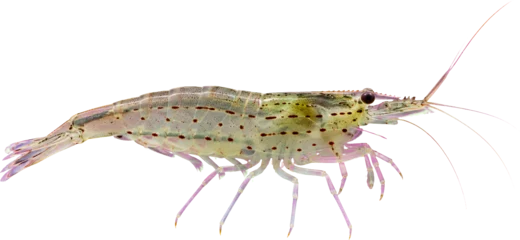
Amano shrimp in the wild
Caridina multidentata lives in coastal rivers of Japan and Taiwan. Adults reach 4–5 cm, with a translucent body marked by reddish-brown dots and dashes along the sides. In the wild the larvae drift down to the sea or brackish water to develop, and the juveniles migrate back upstream into fresh water.
Keeping Amano shrimp in a planted aquarium
In an aquarium it tirelessly eats hair algae, film algae and leftovers, making it one of the most effective algae eaters for a planted tank. It tolerates a range of conditions (about 20–27 °C, pH 6.5–7.5) but is sensitive to copper and medications. Because the larvae need salt water it does not breed in a freshwater tank — numbers only change when you add more. It can climb out along tubing, so keep the tank covered. Once the algae is gone, add algae wafers.
Water values are typical ranges; check with the seller for the exact species and line you buy, and acclimatise new animals slowly.
Classification
- Scientific name
- Caridina multidentata
- Family
- Atyidae (atyid shrimps)
- Adult size
- 4–5 cm
- Food
- Nuisance algae, algae wafers, leftovers
Trade names and colour lines may differ from the scientific name; many colour lines belong to one species.
In the Nuôi Cá aquarium
In the 3D aquarium the shrimp spends most of its time picking at biofilm, taking a few steps and stopping; now and then it has a busy spell, swimming up onto wood, stone, moss or a leaf to graze, and it flicks backwards when you tap the glass. It helps slow the algae on the glass.
Temperament: The best nuisance-algae cleaner; greedy, often grabs the food pellets.
Add it to your aquarium →Sources and further reading
- GBIF — Caridina multidentata (scientific name, taxonomy and distribution)
- OATA — freshwater aquarium care sheets (real aquarium care principles)
The "In the Nuôi Cá aquarium" part describes the 3D simulation; its stocking limits are not real-world care instructions.